Partition (Density, Stochastic): Difference between revisions
Scott Munro (talk | contribs) m (1 revision imported) |
imported>Scott.Munro m (Text replacement - "== References ==" to "{{ReferenceFooter}}") |
||
| (12 intermediate revisions by 3 users not shown) | |||
| Line 1: | Line 1: | ||
== Description == | == Description == | ||
This article describes | This article describes the '''Stochastic''' equation for the partition of particles by size and density in gravity separators.{{Rao et al. (2003)}}{{Rao (2021)}} | ||
The Stochastic formulation is applicable to both dense medium separators and gravity concentration processes. | |||
== Model theory == | == Model theory == | ||
{{ | {{Restricted content}} | ||
<hide> | |||
[[File:PartitionStochastic2.png|thumb|500px|Figure 1. Stochastic model partition to sinks. Each coloured line represents a particle class with the geometric mean size indicated in the series label. The pivot point is evident at a density of 2.53 t/m<sup>3</sup>.]] | |||
[[File:PartitionStochastic3.png|thumb|500px|Figure 2. Stochastic model partition to sinks, using the same model parameters as Figure 1. Each coloured line represents a density class with the specific gravity indicated in the series label.]] | |||
[[File:PartitionStochastic4.png|thumb|500px|Figure 3. Modified Stochastic model partition to sinks, using the same model parameters as Figure 1 except time, <math>t</math>, which is half the original value. Each coloured line represents a density class with the specific gravity indicated in the series label.]] | |||
Rao et al (2003) proposed a model that describes the size-density partition surface in both dense-medium and gravity separators. The Stochastic model is derived from a statistical consideration of particle settling phenomena, and for a steady-state process is:{{Rao et al. (2003)}} | |||
:<math>Y_{ij} = \dfrac{1}{2}\left [ 1 + {\rm erf} \left (B - A{{\bar d}_i}^c ((\rho_{\rm S})_{ij} - \rho_{\rm p})\right ) \right ]</math> | |||
where: | |||
* <math>i</math> is the index of the size interval, <math>i = \{1,2,\dots,q\}</math>, <math>q</math> is the number of size intervals | |||
* <math>j</math> is the index of the density class, <math>j = \{1,2,\dots,m\}</math>, <math>m</math> is the number of density classes | |||
* <math>Y_{ij}</math> is the fraction of the mass of particles in size class <math>i</math> and density class <math>j</math> which are partitioned (recovered) to the underflow/concentrate/sinks stream (frac) | |||
* <math>A</math> is a model parameter that accounts for gravitational and viscous forces of the separation (-) | |||
* <math>c</math> is a model parameter that accounts for turbulence in the separation (-) | |||
* <math>B</math> is a model parameter that accounts for fluid drift force of the separation (-) | |||
* <math>\bar d_{i}</math> is the [[Conversions|geometric mean size]] of particles in size interval <math>i</math> (mm) | |||
* <math>\rho_{\rm S}</math> is the particle density (kg/m<sup>3</sup>) | |||
* <math>\rho_{\rm p}</math> is a model parameter representing the pivot density of separation (kg/m<sup>3</sup>) | |||
Rao (2021) extended the Stochastic model to represent the partition surface of an entire batch jig bed in terms of both slice (cut) height and jigging time.{{Rao (2021)}} The modified Stochastic model is: | |||
:<math> | |||
\begin{array}{c} | |||
Y_{ij} = \dfrac{1}{2} \left [ 1 + {\rm erf} \left ( \dfrac{(h_{\rm l} - h_{\rm f})}{tD} + B - A{{\bar d}_i}^c ((\rho_{\rm S})_{ij} - \rho_{\rm p}) \right ) \right ] & \text{for } 0 \leq h_{\rm l} \leq 1 \text{ and } 0 \leq t \leq t_{\rm eq}\\ | |||
\end{array} | |||
</math> | |||
where: | |||
* <math>h_{\rm l}</math> is the relative slice position of the bed, where 0 is the bottom of the bed and 1 is the top of the bed (m/m) | |||
* <math>h_{\rm f}</math> is the feed particle input bed position, a model parameter (m/m) | |||
* <math>D</math> is a model parameter that accounts for the standard deviation of particle velocities in the separator (-) | |||
* <math>t</math> is thje jigging time of the particles (s) | |||
* <math>t_{\rm eq}</math> is the jigging time required to attain dynamic equilibrium (s) | |||
The modified Stochastic model reduces to the original formulation when <math>(h_{\rm l} - h_{\rm f}) \to 0</math> or <math>t \to \infty</math>, i.e. steady-state. | |||
Rao (2021) does not indicate whether the modified Stochastic model is applicable to dense-medium or gravity concentration processes other than batch jigging. The modified Stochastic model should be applied with caution in such cases. | |||
</hide><div class="user-show"> | |||
=== Partition Metrics === | |||
</div><hide> | |||
Several metrics are provided to characterise the Stochastic model partition curve. | |||
The <math>d_{50}</math>, also known as the ''cut or separation size'', is defined as the size of a particle of a given density which has an even (50%) chance of appearing in either the sinks (concentrate) or floats (tail) stream. The <math>d _{50}</math> size is obtained by rearranging the modified Stochastic model: | |||
:<math>d_{50} =\left ( \dfrac{\frac{(h_{\rm l} - h_{\rm f})}{tD} + B}{A(\rho - \rho_{\rm p})} \right )^{\frac{1}{c}}</math> | |||
The <math>\rho_{50}</math>, also known as the ''cut or separation density'', is defined as the density of a particle of a given size which has an even (50%) chance of appearing in either the sinks (concentrate) or floats (tail) stream. The <math>\rho _{50}</math> density is obtained by rearranging the modified Stochastic model: | |||
:<math>\rho_{50} = \rho_{\rm p} + \left ( \dfrac{\frac{(h_{\rm l} - h_{\rm f})}{tD} + B}{Ad^c} \right )</math> | |||
The ''Ecart Probable'', or <math>E_{\rm p}</math>, is a measure of the deviation of a partition curve from a perfect separation, and is found as: | |||
:<math>E_{\rm p} = - \dfrac{0.476936}{Ad^c}</math> | |||
Finally, the partition coefficient at the pivot point, <math>Y_{\rm p}</math> (frac), is: | |||
:<math>Y_{\rm p} = \dfrac{1}{2} \left [ 1 + {\rm erf} \left ( \dfrac{(h_{\rm l} - h_{\rm f})}{tD} + B) \right ) \right ] </math> | |||
As with the modified Stochastic model, the partition metrics above reduce to their steady-state counterparts as <math>(h_{\rm l} - h_{\rm f}) \to 0</math> or <math>t \to \infty</math>. | |||
</hide><div class="user-show"> | |||
=== Cumulative recovery === | |||
</div><hide> | |||
{{Model theory (Text, Gravity Concentrator, Middlings)}} | |||
</hide> | |||
== Excel == | == Excel == | ||
The Stochastic partition equation may be invoked from the Excel formula bar with the following function call: | The Stochastic partition equation may be invoked from the Excel formula bar with the following function call: | ||
<syntaxhighlight lang="vb">= | <syntaxhighlight lang="vb">=mdPartition_Stochastic(MeanSize as Range, RD as Range, A as Double, c as Double, B as Double, rhop as Double, Optional hf as Double = 0, Optional D as double = 0, Optional hl as Double = 0, Optional t as Double = 0, Optional returnPartitionMetrics as Bool = false)</syntaxhighlight> | ||
{{Excel (Text, Help, No Arguments)}} | {{Excel (Text, Help, No Arguments)}} | ||
The input parameters and model results are defined below in matrix notation, along with an example image showing the selection of the same cells in the Excel interface: | |||
:{| | |||
|- style="vertical-align:top;" | |||
| | |||
<math> | |||
\begin{align} | |||
\mathit{MeanSize} & = | |||
\begin{bmatrix} | |||
\bar{d}_1\text{ (mm)}\\ | |||
\vdots\\ | |||
\bar{d}_n\text{ (mm)}\\ | |||
\end{bmatrix}\\ | |||
\\ | |||
\mathit{RD} & = \begin{bmatrix} | |||
(\rho_{\rm S})_{1}\text{ (t/m}^\text{3}\text{)} & \dots & (\rho_{\rm S})_m\text{ (t/m}^\text{3}\text{)}\\ | |||
\end{bmatrix}\\ | |||
\\ | |||
A & = \big [A \big ]\\ | |||
B & = \big [B \big ]\\ | |||
c & = \big [c \big ]\\ | |||
\mathit{rhop} & = \big [\rho_{\rm p} \text{ (t/m}^3\text{))}\big ]\\ | |||
\mathit{hf} & = \big [h_{\rm f}\text{ (m/m)} \big ]\\ | |||
\mathit{hl} & = \big [h_{\rm l}\text{ (m/m)} \big ]\\ | |||
D & = \big [D \big ]\\ | |||
t & = \big [t\text{ (s)} \big ]\\ | |||
\mathit{returnPartitionMetrics} & = \big [(\text{True / False)} \big ]\\ | |||
\\ | |||
\\ | |||
\mathit{mdPartition\_StochasticRao} & = | |||
\begin{bmatrix} | |||
\begin{bmatrix} | |||
Y_{11}\text{ (t/h)} & \dots & Y_{1m}\text{ (t/h)}\\ | |||
\vdots & \ddots & \vdots\\ | |||
Y_{n1}\text{ (t/h)} & \dots & Y_{nm}\text{ (t/h)}\\ | |||
\end{bmatrix} | |||
& | |||
\begin{bmatrix} | |||
(\rho_{50})_1\text{ (t/m}^3\text{)}\\ | |||
\vdots\\ | |||
(\rho_{50})_n\text{ (t/m}^3\text{)}\\ | |||
\end{bmatrix} | |||
& | |||
\begin{bmatrix} | |||
(E_{\rm p})_1\text{ (t/m}^3\text{)}\\ | |||
\vdots\\ | |||
(E_{\rm p})_n\text{ (t/m}^3\text{)}\\ | |||
\end{bmatrix} | |||
& | |||
\begin{array}{c} | |||
\begin{bmatrix} | |||
(d_{50})_{1}\text{ (mm)} & \dots & (d_{50})_m\text{ (mm)}\\ | |||
\end{bmatrix}^{\rm *} | |||
\\ | |||
\\ | |||
\\ | |||
\\ | |||
\end{array} | |||
\end{bmatrix} | |||
\end{align}</math> | |||
where: | |||
* <math>n</math> is the number of size intervals | |||
* <math>m</math> is the number of density classes | |||
* <math>^*</math> indicates optional results returned if <math>\mathit{returnPartitionMetrics = True}</math> | |||
|- style="vertical-align:top;" | |||
| [[File:PartitionStochastic1.png|frame|Figure 2. Example showing the selection of the input parameters (purple, green, pink, brown, teal, blue, red and purple cells), and the '''MeanSize''' (blue frame), '''RD''' (red frame) and '''Results''' (light blue frame) arrays in Excel. The parameter <math>\mathit{returnPartitionMetrics} =\text{True}</math> in this example.]] | |||
|} | |||
== SysCAD == | == SysCAD == | ||
{{ | The Stochastic partition is available from the '''{{Name (Text, Company Name)|nospace=1}}*GravityConcentrator''' and '''{{Name (Text, Company Name)|nospace=1}}*DenseMedium''' unit models. | ||
The sections and variable names used in the SysCAD interface are described in detail in the following tables. | |||
=== Gravity concentrator === | |||
Note that a '''Con''' and '''Partition''' page is provided for each connected concentrate discharge stream. | |||
{{SysCAD (Page, Gravity Concentrator, DLL*GravityConcentrator)}} | |||
==== Con page ==== | |||
The Con page is used to specify the required model method and associated input parameters. | |||
{{SysCAD (Text, Table Header)}} | |||
{{SysCAD (Text, Gravity Concentrator, Con)}} | |||
{{SysCAD (Text, Help Link)}} | |||
|- | |||
! colspan="3" style="text-align:left;" |''Stochastic'' | |||
{{SysCAD (Text, Partition, Stochastic)}} | |||
{{SysCAD (Text, Gravity Concentrator, Liquids)|method=0}} | |||
|} | |||
{{SysCAD (Page, Hydrocyclone, Partition)|ActionU=Partition|ActionL=partition|DestinationU=Concentrate|DestinationL=concentrate|UnitL=gravity concentrator|GravityMetrics=true|Cumulative=true}} | |||
{{SysCAD (Page, About)}} | |||
==== Additional notes ==== | |||
{{SysCAD (Text, No PSD Splits)|gasstream=tail}} | |||
=== Dense medium separator === | |||
{{SysCAD (Page, Dense Medium, DLL*DenseMedium)|ViscosityModel=true}} | |||
==== Stochastic page ==== | |||
The Stochastic page is used to specify the required model method and associated input parameters. | |||
{{SysCAD (Text, Table Header)}} | |||
|- | |||
! colspan="3" style="text-align:left;" |''Stochastic'' | |||
{{SysCAD (Text, Help Link)}} | |||
{{SysCAD (Text, Partition, Stochastic)}} | |||
|- | |||
! colspan="3" style="text-align:left;" |''Medium'' | |||
|- style="vertical-align:top;" | |||
|MediumSolids | |||
|Input / List | |||
|Specifies which species should be considered as the medium solids by the model. | |||
* The drop down list will contain all solids species in the project, plus "-" for no selection. | |||
* See [[#Medium_solids|Medium solids]] for more information. | |||
|- style="vertical-align:top;" | |||
|rowspan="4" | MedSolSeparMethod | |||
|None | |||
|Medium solids are split as if the default ''MediumSolids'' parameter "-" was selected. See above. | |||
|- style="vertical-align:top;" | |||
|Split to Sinks (User) | |||
|The user specifies the fractional split of the selected medium solids species to the sinks stream. | |||
|- style="vertical-align:top;" | |||
|Follow Solids | |||
|The fractional split of the selected medium solids species to the sinks stream is equal to the overall mass split of all other solids to the sinks stream. | |||
|- style="vertical-align:top;" | |||
|Follow Liquids | |||
|The fractional split of the selected medium solids species to the sinks stream is equal to the mass split of liquids to the sinks stream. | |||
|- | |||
|MedSolSplitToSinks | |||
|style="background: #eaecf0" | Input / Display | |||
|Value of the fractional mass split of the selected medium solids to the sinks stream. | |||
{{SysCAD (Text, Dense Medium, Liquids)|method=0}} | |||
|} | |||
{{SysCAD (Page, Hydrocyclone, Partition)|ActionU=Partition|ActionL=partition|DestinationU=Sinks|DestinationL=sinks|UnitL=dense medium separator|GravityMetrics=true}} | |||
==== Viscosity page ==== | |||
This page displays the inputs and results for [[Properties (Dense Medium Viscosity)|dense medium viscosity]] calculations. The page is only visible if ''ViscosityModel'' is selected on the '''{{SysCAD (Text, UnitType Prefix)}}DenseMedium''' page. | |||
{{SysCAD (Page, About)}} | |||
{{SysCAD (Text, Dense Medium, Medium Solids)}} | |||
==== Additional notes ==== | |||
{{SysCAD (Text, No PSD Splits)|gasstream=floats}} | |||
== See also == | |||
* [[Partition (Density, Pivot)]] | |||
* [https://help.syscad.net/Met_Dynamics_-_Gravity_Concentrator Met Dynamics - Gravity Concentrator (help.syscad.net)] | |||
* [https://help.syscad.net/Met_Dynamics_-_Dense_Medium_Separator Met Dynamics - Dense Medium Separator (help.syscad.net)] | |||
{{ReferenceFooter}} | |||
[[Category:Excel]] | [[Category:Excel]] | ||
[[Category:SysCAD]] | [[Category:SysCAD]] | ||
Latest revision as of 13:48, 22 July 2026
Description
This article describes the Stochastic equation for the partition of particles by size and density in gravity separators.[1][2]
The Stochastic formulation is applicable to both dense medium separators and gravity concentration processes.
Model theory
 This content is available to registered users. Please log in to view. This content is available to registered users. Please log in to view.
|
Partition Metrics
Cumulative recovery
Excel
The Stochastic partition equation may be invoked from the Excel formula bar with the following function call:
=mdPartition_Stochastic(MeanSize as Range, RD as Range, A as Double, c as Double, B as Double, rhop as Double, Optional hf as Double = 0, Optional D as double = 0, Optional hl as Double = 0, Optional t as Double = 0, Optional returnPartitionMetrics as Bool = false)
Invoking the function with no arguments will print Help text associated with the model, including a link to this page.
The input parameters and model results are defined below in matrix notation, along with an example image showing the selection of the same cells in the Excel interface:
[math]\displaystyle{ \begin{align} \mathit{MeanSize} & = \begin{bmatrix} \bar{d}_1\text{ (mm)}\\ \vdots\\ \bar{d}_n\text{ (mm)}\\ \end{bmatrix}\\ \\ \mathit{RD} & = \begin{bmatrix} (\rho_{\rm S})_{1}\text{ (t/m}^\text{3}\text{)} & \dots & (\rho_{\rm S})_m\text{ (t/m}^\text{3}\text{)}\\ \end{bmatrix}\\ \\ A & = \big [A \big ]\\ B & = \big [B \big ]\\ c & = \big [c \big ]\\ \mathit{rhop} & = \big [\rho_{\rm p} \text{ (t/m}^3\text{))}\big ]\\ \mathit{hf} & = \big [h_{\rm f}\text{ (m/m)} \big ]\\ \mathit{hl} & = \big [h_{\rm l}\text{ (m/m)} \big ]\\ D & = \big [D \big ]\\ t & = \big [t\text{ (s)} \big ]\\ \mathit{returnPartitionMetrics} & = \big [(\text{True / False)} \big ]\\ \\ \\ \mathit{mdPartition\_StochasticRao} & = \begin{bmatrix} \begin{bmatrix} Y_{11}\text{ (t/h)} & \dots & Y_{1m}\text{ (t/h)}\\ \vdots & \ddots & \vdots\\ Y_{n1}\text{ (t/h)} & \dots & Y_{nm}\text{ (t/h)}\\ \end{bmatrix} & \begin{bmatrix} (\rho_{50})_1\text{ (t/m}^3\text{)}\\ \vdots\\ (\rho_{50})_n\text{ (t/m}^3\text{)}\\ \end{bmatrix} & \begin{bmatrix} (E_{\rm p})_1\text{ (t/m}^3\text{)}\\ \vdots\\ (E_{\rm p})_n\text{ (t/m}^3\text{)}\\ \end{bmatrix} & \begin{array}{c} \begin{bmatrix} (d_{50})_{1}\text{ (mm)} & \dots & (d_{50})_m\text{ (mm)}\\ \end{bmatrix}^{\rm *} \\ \\ \\ \\ \end{array} \end{bmatrix} \end{align} }[/math]
where:- [math]\displaystyle{ n }[/math] is the number of size intervals
- [math]\displaystyle{ m }[/math] is the number of density classes
- [math]\displaystyle{ ^* }[/math] indicates optional results returned if [math]\displaystyle{ \mathit{returnPartitionMetrics = True} }[/math]
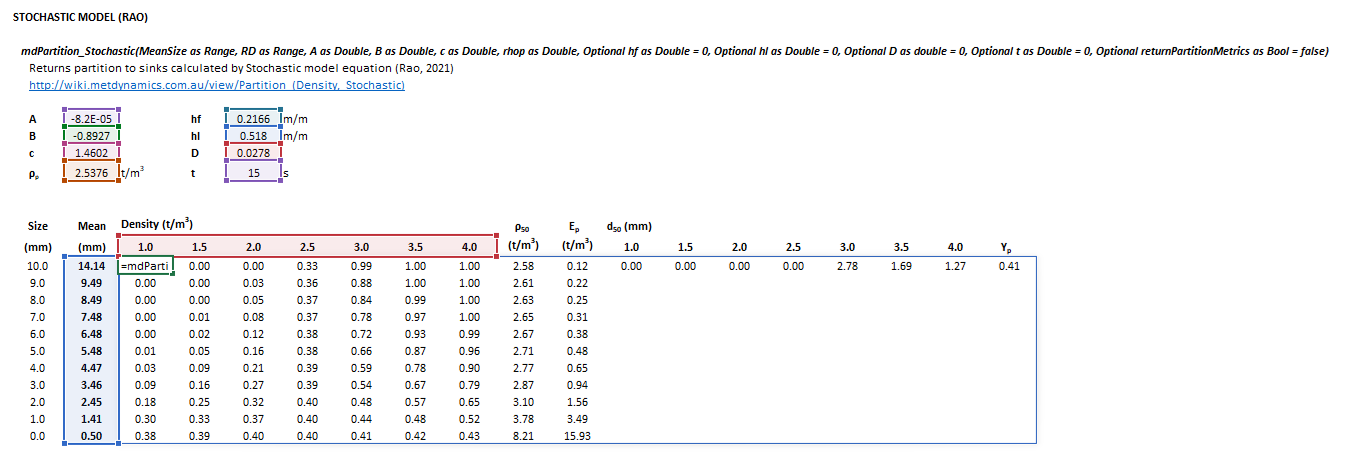 Figure 2. Example showing the selection of the input parameters (purple, green, pink, brown, teal, blue, red and purple cells), and the MeanSize (blue frame), RD (red frame) and Results (light blue frame) arrays in Excel. The parameter [math]\displaystyle{ \mathit{returnPartitionMetrics} =\text{True} }[/math] in this example.

SysCAD
The Stochastic partition is available from the MetDynamics*GravityConcentrator and MetDynamics*DenseMedium unit models.
The sections and variable names used in the SysCAD interface are described in detail in the following tables.
Gravity concentrator
Note that a Con and Partition page is provided for each connected concentrate discharge stream.
MD_GravityConcentrator page
The first tab page in the access window will have this name.
| Tag (Long/Short) | Input / Display | Description/Calculated Variables/Options |
|---|---|---|
| Tag | Display | This name tag may be modified with the change tag option. |
| Condition | Display | OK if no errors/warnings, otherwise lists errors/warnings. |
| ConditionCount | Display | The current number of errors/warnings. If condition is OK, returns 0. |
| GeneralDescription / GenDesc | Display | This is an automatically generated description for the unit. If the user has entered text in the 'EqpDesc' field on the Info tab (see below), this will be displayed here.
If this field is blank, then SysCAD will display the unit class ID. |
| Requirements | ||
| On | CheckBox | This enables the unit. If this box is not checked, then the MassFracToCon option appears below. |
| MassFracToCon | Input | Only appears if the On field above is not checked. Specifies the fraction of feed mass that reports to the concentrate stream when the model is off. |
| NumParallelUnits | Input | The number of parallel, identical units to simulate:
|
| Options | ||
| ShowQFeed | CheckBox | QFeed and associated tab pages (eg Sp) will become visible, showing the properties of the combined feed stream. |
| SizeForPassingFracCalc | Input | Size fraction for % Passing calculation. The size fraction input here will be shown in the Stream Summary section. |
| FracForPassingSizeCalc | Input | Fraction passing for Size calculation. The fraction input here will be shown in the Stream Summary section. |
| Stream Summary | ||
| MassFlow / Qm | Display | The total mass flow in each stream. |
| SolidMassFlow / SQm | Display | The Solids mass flow in each stream. |
| LiquidMassFlow / LQm | Display | The Liquid mass flow in each stream. |
| VolFlow / Qv | Display | The total Volume flow in each stream. |
| Temperature / T | Display | The Temperature of each stream. |
| Density / Rho | Display | The Density of each stream. |
| SolidFrac / Sf | Display | The Solid Fraction in each stream. |
| LiquidFrac / Lf | Display | The Liquid Fraction in each stream. |
| Passing | Display | The mass fraction passing the user-specified size (in the field SizeForPassingFracCalc) in each stream. |
| Passes | Display | The user-specified (in the field FracForPassesSizeCalc) fraction of material in each stream will pass this size fraction. |
Con page
The Con page is used to specify the required model method and associated input parameters.
| Tag (Long/Short) | Input / Display | Description/Calculated Variables/Options |
|---|---|---|
| Stage | ||
| On | Checkbox | This enables the stage. If off, the feed to this stage passes directly to the next stage (or tail) without partition. |
| Method | Partition (User) | The partition to concentrate for each size interval is defined by the user. |
| Partition (Rho50-Ep) | The partition to concentrate for each species and size interval is defined by the Rho50-Ep model. | |
| Partition (Pivot) | The partition to concentrate for each species and size interval is defined by the Pivot model. | |
| Partition (Stochastic) | The partition to concentrate for species and each size interval is defined by the Stochastic model. | |
| Partition (Bazin) | The partition to concentrate for species and each size interval is defined by the Bazin model. | |
| Jig (King) | The partition to concentrate for species and each size interval is defined by the King jig stratification model. | |
| Spiral (Tucker) | The partition to concentrate for each species and size interval is defined by the Tucker spiral concentrator model. | |
| Shaking Table (Tucker) | The partition to concentrate for each species and size interval is defined by the Tucker shaking table model. | |
| Falcon (Kroll-Rabotin) | The partition to concentrate for each species and size interval is defined by the Kroll-Rabotin Falcon concentrator model. | |
| Knelson (Chen) | The partition to concentrate for each species and size interval is defined by the Chen Knelson concentrator model. | |
| Multi-Gravity (Tucker) | The partition to concentrate for each species and size interval is defined by the Tucker Multi-Gravity Separator model. | |
| HelpLink | 
|
Opens a link to this page using the system default web browser. Note: Internet access is required. |
| Stochastic | ||
| A | Input | Partition surface parameter, gravitation and viscous forces. |
| B | Input | Partition surface parameter, fluid drift force. |
| c | Input | Partition surface parameter, turbulence. |
| PivotDensity / Rhop | Input | Density at pivot point. |
| hf | Input | Feed particle input bed position. |
| hl | Input | Slice position of the particle bed. |
| D | Input | Partition surface parameter, standard deviation of particle velocities. |
| t | Input | Separation period of particles. |
| Liquids | ||
| LiquidsSeparMethod | Split To Con (User) | Liquids are split to concentrate by a user-defined fraction of liquids in the feed. |
| Con Solids Fraction | Sufficient liquids mass is recovered to the concentrate stream to yield the user-defined concentrate solids mass fraction value (if possible). | |
| Con Liquids Fraction | Sufficient liquids mass is recovered to the concentrate stream to yield the user-defined concentrate liquids mass fraction value (if possible). | |
| ConSolidsFracReqd / Con.SfReqd | Input | Required value of the mass fraction of solids in the concentrate stream. Only visible if Con Solids Fraction is selected. |
| ConLiquidsFracReqd / Con.LfReqd | Input | Required value of the mass fraction of liquids in the concentrate stream. Only visible if Con Liquids Fraction is selected. |
| LiqSplitToCon / Con.LiqSplit | Input/Display | The fraction of feed liquids recovered to the concentrate stream. |
Partition page
The Partition page is used to display (or specify) the partition by species/component/element/individual phase and size values.
| Tag (Long/Short) | Input / Display | Description/Calculated Variables/Options |
|---|---|---|
| Distribution | ||
| Name | Display | Shows the name of the SysCAD Size Distribution (PSD) quality associated with the feed stream. |
| IntervalCount | Display | Shows the number of size intervals in the SysCAD Size Distribution (PSD) quality associated with the feed stream. |
| SpWithPSDCount | Display | Shows the number of species in the feed stream assigned with the SysCAD Size Distribution (PSD) quality.
|
| CumulativePartition | ||
| Method | Model / User | Select model-calculated or user-defined cumulative partition to separate each solids species type. |
| Density | Display | Density of each solid species. |
| Size | Display | Size of each interval in mesh series. |
| MeanSize | Display | Geometric mean size of each interval in mesh series.
|
| All (All column) | Display |
|
| CumulativePartition | Display |
|
| All (All row, All column) | Display |
|
| All (All row, per species) | Display |
|
| Partition | ||
| Method | Model / User | Select model-calculated or user-defined partition to separate each solids species type. |
| Density | Display | Density of each solid species. |
| Size | Display | Size of each interval in mesh series. |
| MeanSize | Display | Geometric mean size of each interval in mesh series.
|
| All (All column) | Display |
|
| Partition | Display |
|
| All (All row, All column) | Display |
|
| All (All row, per species) | Display |
|
| CmpPartition | ||
| Components |   |
Hides or shows component partition table. |
| Size | Display | Size of each interval in mesh series. |
| MeanSize | Display | Geometric mean size of each interval in mesh series. |
| All (All column) | Display |
|
| CmpPartition | Display |
|
| All (All row, All column) | Display |
|
| All (All row, per component) | Display |
|
| ElePartition | ||
| Elements |   |
Hides or shows element partition table. |
| Size | Display | Size of each interval in mesh series. |
| MeanSize | Display | Geometric mean size of each interval in mesh series. |
| All (All column) | Display |
|
| ElePartition | Display |
|
| All (All row, All column) | Display |
|
| All (All row, per element) | Display |
|
| IPhPartition | ||
| IPhases |   |
Hides or shows individual phases partition table. |
| Size | Display | Size of each interval in mesh series. |
| MeanSize | Display | Geometric mean size of each interval in mesh series. |
| All (All column) | Display |
|
| IPhPartition | Display |
|
| All (All row, All column) | Display |
|
| All (All row, per individual phase) | Display |
|
| PartitionMetrics | ||
| d50 | Display | Cut size (d50) of separation of each ore species. |
| Size | Display | Size of each interval in mesh series. |
| MeanSize | Display | Geometric mean size of each interval in mesh series. |
| CutDensity / Rho50 | Display | Cut density (Rho50) of all particles in each size interval. |
| EcartProbable / Ep | Display | Ecart Probable of all particles in each size interval. |
| PivotPartition / Yp | Display | Partition at pivot point. |
About page
This page is provides product and licensing information about the Met Dynamics Models SysCAD Add-On.
| Tag (Long/Short) | Input / Display | Description/Calculated Variables/Options |
|---|---|---|
| About | ||
| HelpLink | 
|
Opens a link to the Installation and Licensing page using the system default web browser. Note: Internet access is required. |
| Information | 
|
Copies Product and License information to the Windows clipboard. |
| Product | ||
| Name | Display | Met Dynamics software product name |
| Version | Display | Met Dynamics software product version number. |
| BuildDate | Display | Build date and time of the Met Dynamics Models SysCAD Add-On. |
| License | ||
| File | 
|
This is used to locate a Met Dynamics software license file. |
| Location | Display | Type of Met Dynamics software license or file name and path of license file. |
| SiteCode | Display | Unique machine identifier for license authorisation. |
| ReqdAuth | Display | Authorisation level required, MD-SysCAD Full or MD-SysCAD Runtime. |
| Status | Display | License status, LICENSE_OK indicates a valid license, other messages report licensing errors. |
| IssuedTo | Display | Only visible if Met Dynamics license file is used. Name of organisation/seat the license is authorised to. |
| ExpiryDate | Display | Only visible if Met Dynamics license file is used. License expiry date. |
| DaysLeft | Display | Only visible if Met Dynamics license file is used. Days left before the license expires. |
Additional notes
- Solid species that do not possess a particle size distribution property are split according to the overall mass split of the default particle size distribution species selected in the SysCAD Project Configuration.
- If the default particle size distribution species is not present in the unit feed, the overall split of all other species with particle size distributions combined is used, as determined by the model.
- Gas phase species report directly to the tail stream without split.
Dense medium separator
MD_DenseMedium page
The first tab page in the access window will have this name.
| Tag (Long/Short) | Input / Display | Description/Calculated Variables/Options |
|---|---|---|
| Tag | Display | This name tag may be modified with the change tag option. |
| Condition | Display | OK if no errors/warnings, otherwise lists errors/warnings. |
| ConditionCount | Display | The current number of errors/warnings. If condition is OK, returns 0. |
| GeneralDescription / GenDesc | Display | This is an automatically generated description for the unit. If the user has entered text in the 'EqpDesc' field on the Info tab (see below), this will be displayed here.
If this field is blank, then SysCAD will display the unit class ID. |
| Requirements | ||
| On | CheckBox | This enables the unit. If this box is not checked, then the MassFracToSinks option appears below. |
| MassFracToSinks | Input | Only appears if the On field above is not checked. Specifies the fraction of feed mass that reports to the sinks stream when the model is off. |
| NumParallelUnits | Input | The number of parallel, identical units to simulate:
|
| Method | Partition (User) | The partition to sinks for each size interval and species is defined by the user. |
| Partition (Rho50-Ep) | The partition to sinks for each species and size interval is defined by the Rh050-Ep model. | |
| Partition (Pivot) | The partition to sinks for each species and size interval is defined by the Pivot model. | |
| Partition (Stochastic) | The partition to sinks for each species and size interval is defined by the Stochastic model. | |
| Drum (Baguley) | The Baguley dense medium drum model is used to determine the partition of solids to sinks and floats for each species and size interval. | |
| Cyclone (Dunglison) | The Dunglison dense medium cyclone model is used to determine the partition of solids to sinks (underflow) and floats (overflow) for each species and size interval. | |
| ViscosityModel | CheckBox | Show dense medium viscosity model on the Viscosity page. |
| Options | ||
| ShowQFeed | CheckBox | QFeed and associated tab pages (eg Sp) will become visible, showing the properties of the combined feed stream. |
| ShowQSinks | CheckBox | QSinks and associated tab pages (eg Sp) will become visible, showing the properties of the sinks stream. |
| ShowQFloats | CheckBox | QFloats and associated tab pages (eg Sp) will become visible, showing the properties of the floats stream. |
| SizeForPassingFracCalc | Input | Size fraction for % Passing calculation. The size fraction input here will be shown in the Stream Summary section. |
| FracForPassingSizeCalc | Input | Fraction passing for Size calculation. The fraction input here will be shown in the Stream Summary section. |
| Stream Summary | ||
| MassFlow / Qm | Display | The total mass flow in each stream. |
| SolidMassFlow / SQm | Display | The Solids mass flow in each stream. |
| LiquidMassFlow / LQm | Display | The Liquid mass flow in each stream. |
| VolFlow / Qv | Display | The total Volume flow in each stream. |
| Temperature / T | Display | The Temperature of each stream. |
| Density / Rho | Display | The Density of each stream. |
| SolidFrac / Sf | Display | The Solid Fraction in each stream. |
| LiquidFrac / Lf | Display | The Liquid Fraction in each stream. |
| Passing | Display | The mass fraction passing the user-specified size (in the field SizeForPassingFracCalc) in each stream. |
| Passes | Display | The user-specified (in the field FracForPassesSizeCalc) fraction of material in each stream will pass this size fraction. |
Stochastic page
The Stochastic page is used to specify the required model method and associated input parameters.
| Tag (Long/Short) | Input / Display | Description/Calculated Variables/Options |
|---|---|---|
| Stochastic | ||
| HelpLink |
|
Opens a link to this page using the system default web browser. Note: Internet access is required. |
| A | Input | Partition surface parameter, gravitation and viscous forces. |
| B | Input | Partition surface parameter, fluid drift force. |
| c | Input | Partition surface parameter, turbulence. |
| PivotDensity / Rhop | Input | Density at pivot point. |
| hf | Input | Feed particle input bed position. |
| hl | Input | Slice position of the particle bed. |
| D | Input | Partition surface parameter, standard deviation of particle velocities. |
| t | Input | Separation period of particles. |
| Medium | ||
| MediumSolids | Input / List | Specifies which species should be considered as the medium solids by the model.
|
| MedSolSeparMethod | None | Medium solids are split as if the default MediumSolids parameter "-" was selected. See above. |
| Split to Sinks (User) | The user specifies the fractional split of the selected medium solids species to the sinks stream. | |
| Follow Solids | The fractional split of the selected medium solids species to the sinks stream is equal to the overall mass split of all other solids to the sinks stream. | |
| Follow Liquids | The fractional split of the selected medium solids species to the sinks stream is equal to the mass split of liquids to the sinks stream. | |
| MedSolSplitToSinks | Input / Display | Value of the fractional mass split of the selected medium solids to the sinks stream. |
| Liquids | ||
| LiquidsSeparMethod | Split To Sinks (User) | Liquids are split to sinks by a user-defined fraction of liquids in the feed. |
| Sinks Solids Fraction | Sufficient liquids mass is recovered to the sinks stream to yield the user-defined sinks solids mass fraction value (if possible). | |
| Sinks Liquids Fraction | Sufficient liquids mass is recovered to the sinks stream to yield the user-defined sinks liquids mass fraction value (if possible). | |
| SinksSolidsFracReqd / Sinks.SfReqd | Input | Required value of the mass fraction of solids in the sinks stream. Only visible if Sinks Solids Fraction is selected. |
| SinksLiquidsFracReqd / Sinks.LfReqd | Input | Required value of the mass fraction of liquids in the sinks stream. Only visible if Sinks Liquids Fraction is selected. |
| LiqSplitToSinks / Sinks.LiqSplit | Input/Display | The fraction of feed liquids recovered to the sinks stream. |
Partition page
The Partition page is used to display (or specify) the partition by species/component/element/individual phase and size values.
| Tag (Long/Short) | Input / Display | Description/Calculated Variables/Options |
|---|---|---|
| Distribution | ||
| Name | Display | Shows the name of the SysCAD Size Distribution (PSD) quality associated with the feed stream. |
| IntervalCount | Display | Shows the number of size intervals in the SysCAD Size Distribution (PSD) quality associated with the feed stream. |
| SpWithPSDCount | Display | Shows the number of species in the feed stream assigned with the SysCAD Size Distribution (PSD) quality. |
| Partition | ||
| Method | Model / User | Select model-calculated or user-defined partition to separate each solids species type. |
| Density | Display | Density of each solid species. |
| Size | Display | Size of each interval in mesh series. |
| MeanSize | Display | Geometric mean size of each interval in mesh series.
|
| All (All column) | Display |
|
| Partition | Display |
|
| All (All row, All column) | Display |
|
| All (All row, per species) | Display |
|
| CmpPartition | ||
| Components | |
Hides or shows component partition table. |
| Size | Display | Size of each interval in mesh series. |
| MeanSize | Display | Geometric mean size of each interval in mesh series. |
| All (All column) | Display |
|
| CmpPartition | Display |
|
| All (All row, All column) | Display |
|
| All (All row, per component) | Display |
|
| ElePartition | ||
| Elements | |
Hides or shows element partition table. |
| Size | Display | Size of each interval in mesh series. |
| MeanSize | Display | Geometric mean size of each interval in mesh series. |
| All (All column) | Display |
|
| ElePartition | Display |
|
| All (All row, All column) | Display |
|
| All (All row, per element) | Display |
|
| IPhPartition | ||
| IPhases | |
Hides or shows individual phases partition table. |
| Size | Display | Size of each interval in mesh series. |
| MeanSize | Display | Geometric mean size of each interval in mesh series. |
| All (All column) | Display |
|
| IPhPartition | Display |
|
| All (All row, All column) | Display |
|
| All (All row, per individual phase) | Display |
|
| PartitionMetrics | ||
| d50 | Display | Cut size (d50) of separation of each ore species. |
| Size | Display | Size of each interval in mesh series. |
| MeanSize | Display | Geometric mean size of each interval in mesh series. |
| CutDensity / Rho50 | Display | Cut density (Rho50) of all particles in each size interval. |
| EcartProbable / Ep | Display | Ecart Probable of all particles in each size interval. |
| PivotPartition / Yp | Display | Partition at pivot point. |
Viscosity page
This page displays the inputs and results for dense medium viscosity calculations. The page is only visible if ViscosityModel is selected on the MD_DenseMedium page.
About page
This page is provides product and licensing information about the Met Dynamics Models SysCAD Add-On.
| Tag (Long/Short) | Input / Display | Description/Calculated Variables/Options |
|---|---|---|
| About | ||
| HelpLink |
|
Opens a link to the Installation and Licensing page using the system default web browser. Note: Internet access is required. |
| Information |
|
Copies Product and License information to the Windows clipboard. |
| Product | ||
| Name | Display | Met Dynamics software product name |
| Version | Display | Met Dynamics software product version number. |
| BuildDate | Display | Build date and time of the Met Dynamics Models SysCAD Add-On. |
| License | ||
| File |
|
This is used to locate a Met Dynamics software license file. |
| Location | Display | Type of Met Dynamics software license or file name and path of license file. |
| SiteCode | Display | Unique machine identifier for license authorisation. |
| ReqdAuth | Display | Authorisation level required, MD-SysCAD Full or MD-SysCAD Runtime. |
| Status | Display | License status, LICENSE_OK indicates a valid license, other messages report licensing errors. |
| IssuedTo | Display | Only visible if Met Dynamics license file is used. Name of organisation/seat the license is authorised to. |
| ExpiryDate | Display | Only visible if Met Dynamics license file is used. License expiry date. |
| DaysLeft | Display | Only visible if Met Dynamics license file is used. Days left before the license expires. |
Medium solids
This model allows the user to designate any single SysCAD solids species in the project as the medium solids. Alternatively, no medium solids may be specified (default: "-").
The selected option determines how the medium species is treated by the model:
- Default: -:
- All solids species in the feed stream that possess the size distribution (PSD) property are partitioned by the model based on their size and density characteristics.
- The All partition values shown on the Partition page include contributions from all species.
- All solids species in the feed stream that do not possess the PSD property are split by the model based on default behaviour (see Additional notes).
- [Species Name]:
- The user may specify how the selected medium solids species is split to the sinks stream via the MedSolSeparMethod field. Options are:
- None: Medium solids are split as if the default MediumSolids parameter "-" was selected. See above.
- Split to Sinks (User): The user specifies the fractional split of the selected medium solids species to the sinks stream.
- Follow Solids: The fractional split of the selected medium solids species to the sinks stream is equal to the overall mass split of all other solids to the sinks stream.
- Follow Liquids: The fractional split of the selected medium solids species to the sinks stream is equal to the mass split of liquids to the sinks stream.
- if the selected medium solids species posseses the PSD property:
- The partition-by-size values for the medium species on the Partition page are displayed as zeroes.
- The All partition values on the Partition page exclude the medium solids species.
- The user may specify how the selected medium solids species is split to the sinks stream via the MedSolSeparMethod field. Options are:
Additional notes
- Solid species that do not possess a particle size distribution property are split according to the overall mass split of the default particle size distribution species selected in the SysCAD Project Configuration.
- If the default particle size distribution species is not present in the unit feed, the overall split of all other species with particle size distributions combined is used, as determined by the model.
- Gas phase species report directly to the floats stream without split.
See also
- Partition (Density, Pivot)
- Met Dynamics - Gravity Concentrator (help.syscad.net)
- Met Dynamics - Dense Medium Separator (help.syscad.net)