Tumbling Mill (Media Strings): Difference between revisions
Scott Munro (talk | contribs) m (1 revision imported) |
imported>Scott.Munro m (→Model theory) |
||
| Line 12: | Line 12: | ||
== Model theory == | == Model theory == | ||
{{Restricted content}} | |||
<hide> | |||
=== Grinding media wear kinetics === | === Grinding media wear kinetics === | ||
| Line 98: | Line 101: | ||
which may provide a useful estimate for media string calculations. | which may provide a useful estimate for media string calculations. | ||
</hide> | |||
== Excel == | == Excel == | ||
Revision as of 11:20, 4 December 2024
Description
The article outlines a methodology for estimating the size distribution of media elements in grinding mills at recharge equilibrium, as proposed by Sepúlveda (2004):[1]
- The constant recharging, wearing and ejection of media elements in a mill results in a string of worn media elements of distributed sizes which descended from an original unworn (make-up) element.
- Charging a mill with a mixture of new media make-up sizes results in multiple strings coexisting, and combining into an effective overall string.
- When the addition rate of new media elements matches the ejection rate of scrap elements, the media strings are said to be in recharge equilibrium.
Sepúlveda mathematically derives an approach to estimating the mass weight by size distribution of both individual and overall combined strings at recharge equilibrium.
This information may be useful for understanding the effect of changing recharge media sizes or proportions on the overall distribution of media in a mill. It may also be useful for simulation purposes, where either full media size distributions or characteristic sizes are input parameters (e.g. AG/SAG, Perfect Mixing ball mill).
Model theory
 This content is available to registered users. Please log in to view. This content is available to registered users. Please log in to view.
|
Excel
The grinding mill media strings model may be invoked from the Excel formula bar with the following function call:
=mdMillMediaStrings(Size as Range, TopSize as Range, RechargePolicy as Range, scrapSize as Double)
Invoking the function with no arguments will print Help text associated with the model, including a link to this page.
The input arrays and model results are defined below in matrix notation, along with example images showing the selection of the same arrays in the Excel interface:
[math]\displaystyle{ \begin{array}{l} Size = \begin{bmatrix} d_{1}\text{ (mm)}\\ \vdots\\ d_n\text{ (mm)}\\ \end{bmatrix}, & & & \begin{array}{lll} TopSize= \begin{bmatrix} {(d^{\rm R}})_{1}\text{ (mm)} & \dots & {(d^{\rm R}})_m\text{ (mm)}\\ \end{bmatrix}, & & & RechargePolicy = \begin{bmatrix} r_1\text{ (w/w)} & \dots & r_{\rm m}\text{ (w/w)}\\ \end{bmatrix} & & & scrapSize = \left [ d^{\rm S} \right ] \end{array} \end{array} }[/math]
[math]\displaystyle{ mdMillMediaStrings = \begin{bmatrix} \begin{bmatrix} - \end{bmatrix} & \begin{bmatrix} v_1\text{ (v/v)} & \dots & v_m\text{ (v/v)}\\ \end{bmatrix} & \begin{bmatrix} - \end{bmatrix} & \begin{bmatrix} - \end{bmatrix} & \begin{bmatrix} - \end{bmatrix} \\ \begin{bmatrix} - \end{bmatrix} & \begin{bmatrix} a_1\text{ (m}^2\text{/m}^3\text{)} & \dots & a_m\text{ (m}^2\text{/m}^3\text{)}\\ \end{bmatrix} & \begin{bmatrix} a_{\rm All}\text{ (m}^2\text{/m}^3\text{)} \end{bmatrix} & \begin{bmatrix} - \end{bmatrix} & \begin{bmatrix} - \end{bmatrix}\\ \begin{bmatrix} - \end{bmatrix} & \begin{bmatrix} (P_{50})_1\text{ (mm)} & \dots & (P_{50})_m\text{ (mm)}\\ \end{bmatrix} & \begin{bmatrix} (P_{50})_{\rm All}\text{ (mm)} \end{bmatrix} & \begin{bmatrix} - \end{bmatrix} & \begin{bmatrix} - \end{bmatrix}\\ \begin{bmatrix} \bar d_{1}\text{ (mm)}\\ \vdots\\ \bar d_n\text{ (mm)}\\ \end{bmatrix} & \begin{bmatrix} F_3(d_1)_1\text{ (CFP)} & \dots & F_3(d_1)_m\text{ (CFP)}\\ \vdots & \ddots & \vdots\\ F_3(d_n)_1\text{ (CFP)} & \dots & F_3(d_n)_m\text{ (CFP)}\\ \end{bmatrix} & \begin{bmatrix} F_3(d_1)_{\rm All}\text{ (CFP)}\\ \vdots\\ F_3(d_n)_{\rm All}\text{ (CFP)}\\ \end{bmatrix} & \begin{bmatrix} f_3(d_1)_1\text{ (WFR)} & \dots & f_3(d_1)_m\text{ (WFR)}\\ \vdots & \ddots & \vdots\\ f_3(d_n)_1\text{ (WFR)} & \dots & f_3(d_n)_m\text{ (WFR)}\\ \end{bmatrix} & \begin{bmatrix} f_3(d_1)_{\rm All}\text{ (WFR)}\\ \vdots\\ f_3(d_n)_{\rm All}\text{ (WFR)}\\ \end{bmatrix} \end{bmatrix}\;\;\;\;\;\; }[/math]
where [math]\displaystyle{ P_{50} }[/math] is the median size, the 50% passing size (mm).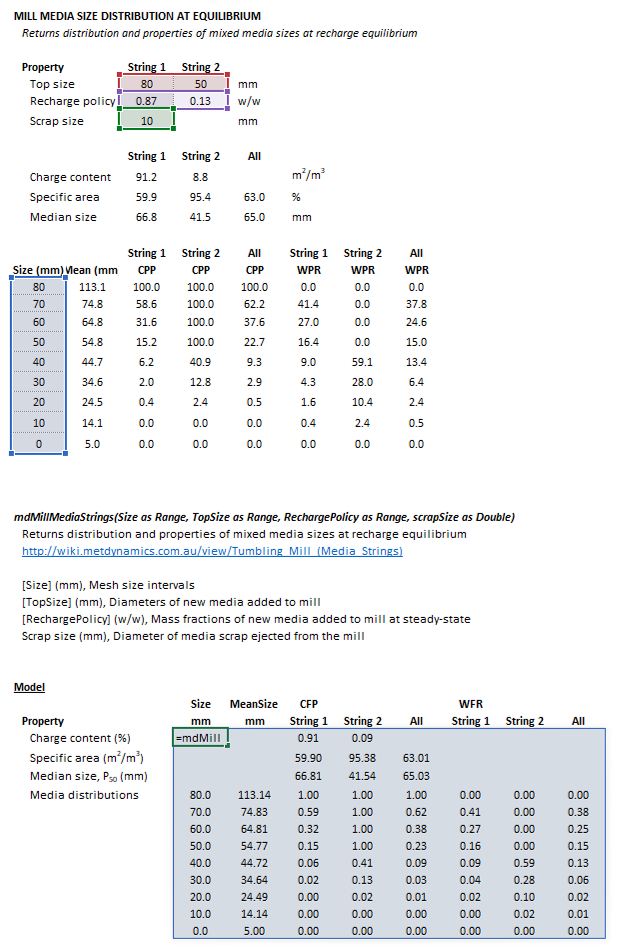 Figure 1. Example showing the selection of the Size (blue frame), TopSize (red frame), RechargePolicy (purple frame), scrapSize (green frame), and Results (light blue frame) arrays in Excel.

SysCAD
Media strings are an optional calculation for grinding mill units. If selected, the input and display parameters below are shown.
| Tag (Long/Short) | Input / Display | Description/Calculated Variables/Options |
|---|---|---|
| MediaStrings | ||
| HelpLink | 
|
Opens a link to this page using the system default web browser. Note: Internet access is required. |
| Requirements | ||
| NumStrings | Input | Number of media strings (i.e. media recharge sizes) |
| TopSize | Input | Diameter of the recharge media by string |
| Recharge | Input | Recharge policy, fractions of each media make-up size added to the mill when recharging. |
| Results | ||
| ChargeContent | Display | Fraction of each string in the combined charge at equilibrium. |
| SpecificArea | Display | Specific surface area of each media string and all strings combined. |
| Size | Display | Size of each interval in mesh series. |
| MedianSize | Display | Median particle diameter (P50), by string and for all strings combined. |
| MeanSize | Display | Geometric mean size of each interval in mesh series. |
| Cumulative | Display | Cumulative mass fraction passing size distribution of media at recharge equilibrium, by string and for all strings combined. |
| Retained | Display | mass fraction retained size distribution of media at recharge equilibrium, by string and for all strings combined. |